AI4Nature is launched: the next-generation Digital Twin developed by NeMeA Sistemi for the Calich Lagoon
Satellite data, marine robotics and predictive models at the heart of the research and development initiative of NeMeA Sistemi for the monitoring of lagoon ecosystems.
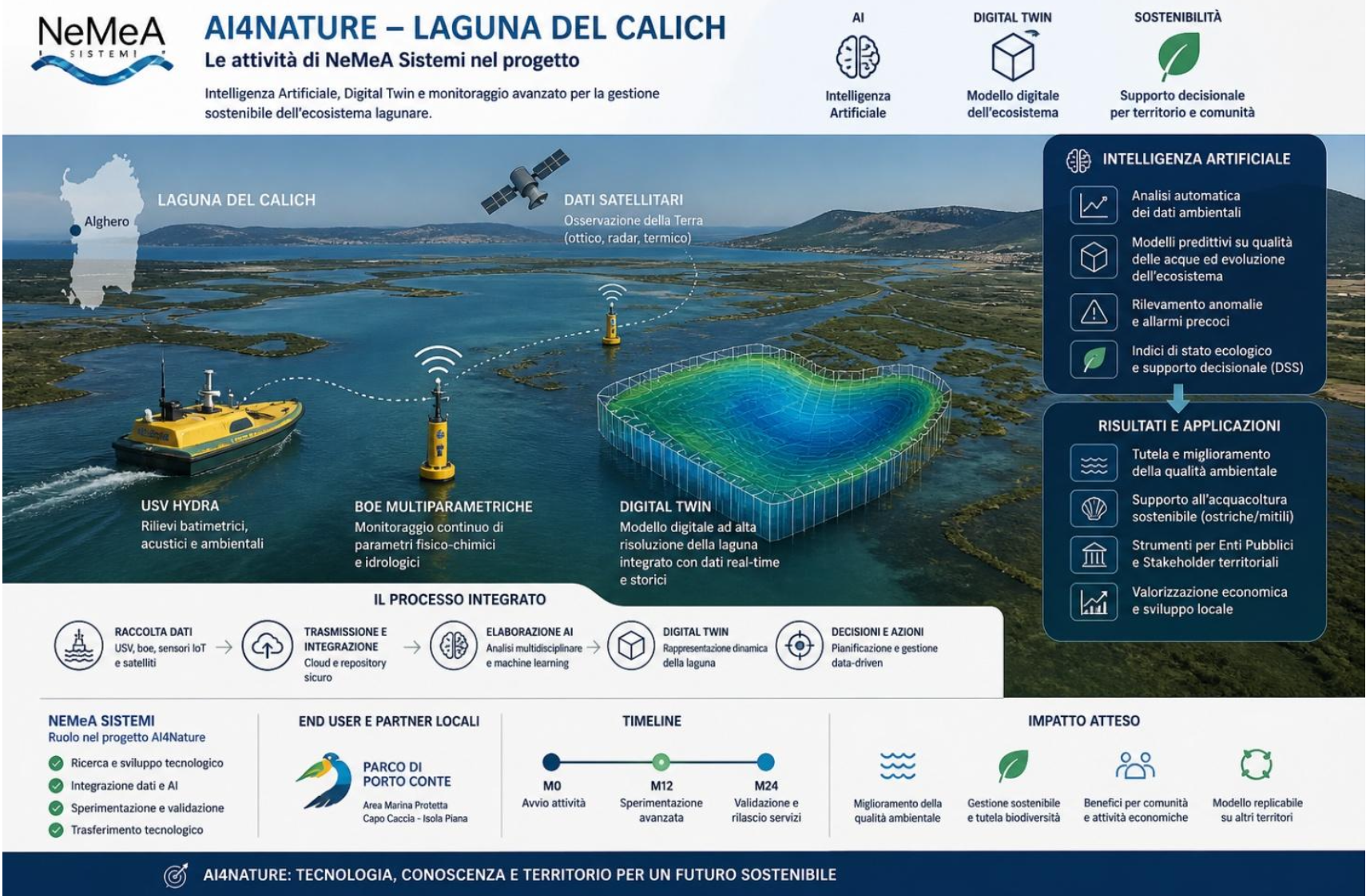
AI4Nature, literally ‘Artificial Intelligence for Nature’, has officially entered its operational phase. The project applies advanced technologies to the study of biodiversity, environmental risk assessment and sustainable land management. Over a period of 24 months, NeMeA Sistemi is working on the development of the eco-robotics and of the Environmental Digital Twin, whilst the Porto Conte Park Special Agency is participating as an institutional end user.
The aim is to develop an integrated system capable of to monitor lagoon habitats on an ongoing basis, interpret their evolution and transform complex data into useful information for those involved in the protection and management of the territory. Coastal lagoons are transitional environments where freshwater and seawater meet, creating complex ecological balances. Temperature, rainfall, salinity, oxygen levels, exchanges with the sea and human activities can rapidly alter conditions within them. To understand these changes, it is not enough to collect data on an occasional basis. A continuous observation system is required, capable of integrating information from different sources and providing an up-to-date picture of the ecosystem.
AI4Nature meets this need by integrating environmental and bathymetric surveys, IoT sensors, multi-parameter buoys, eco-robotic missions and satellite observations. All this information feeds into the Digital Twin and enables a more accurate representation of what is happening in the real world. On this basis, the following are developed: Artificial Intelligence algorithms, with the aim of analysing data, identifying any anomalies, generating alerts and contributing to the development of predictive models.
From the CaDiT project to a new-generation Digital Twin
AI4Nature draws on and builds upon the experience gained through Calich Digital Twin. With CaDiT, NeMeA has created a monitoring network consisting of multi-parameter buoys, from the HYDRA® eco-robotic system and from satellite data. The information gathered from these sources has been fed into the Digital Twin, creating a dynamic and continuously updatable representation of the ecosystem.
Building on this infrastructure, AI4Nature is expanding the volume, variety and continuity of the available data and introducing the first artificial intelligence networks dedicated to analysing it, the detection of anomalies and the generation of alerts. The greater availability of information will also make it possible to refine the algorithms and develop progressively more accurate and reliable forecasting capabilities. The evolution of the project therefore lies in the transition from a system dedicated to the collection, integration and presentation of data to a more advanced platform, capable of interpreting that data and transforming it into operational guidance.
AI4Nature enhances the Digital Twin through Artificial Intelligence and develops a modular and scalable architecture, designed to be adapted to other regions as well. Artificial Intelligence does not replace scientific observation or field checks. Instead, it enables the processing of large amounts of information, the recognition of recurring patterns and the timely detection of signals that require attention.
From the surface to the seabed with the HYDRA® eco-robotic system
One of AI4Nature’s core technologies is the USV HYDRA®, the autonomous surface drone developed by NeMeA to carry out environmental and bathymetric surveys even in areas that are difficult to reach using traditional tools.
The data collected by HYDRA® is integrated with data from buoys, IoT sensors and Earth observation. Combining these sources makes it possible to monitor changes in the ecosystem more continuously and provides AI networks with a broader and more reliable information base.
The expected result is a decision support system, or DSS, capable of transforming complex technical information into indicators, alerts and scenarios that can be readily used by the bodies responsible for environmental protection and management.
The field trial, carried out in collaboration with the Porto Conte Park, makes it possible to assess both the scientific and technological reliability of the platform and its practical usefulness in conservation and planning activities. The project may also contribute to the development of local sectors linked to environmental quality, such as sustainable aquaculture, for which timely information on water conditions is essential.
From the Calich to a replicable model
AI4Nature is not limited to developing a solution designed for a single location. The monitoring network, the Digital Twin and the Artificial Intelligence networks are designed according to a modular, scalable and adaptable architecture. The system can therefore be configured according to environmental characteristics, available technologies and the needs of the organisations managing the area. This approach will facilitate its application in other wetlands and different ecosystems as well.
The expected outcomes include strengthening public monitoring capabilities, supporting strategic decision-making on conservation and local development, and defining methodologies that can be replicated in different areas, with a view to possible application on a national scale.
The project forms part of the national programmes supported by the European Structural Funds for research, innovation and the green and digital transition. Public funding fosters collaboration between research organisations, businesses and local authorities, and enables the technologies developed during the experimental phase to be transferred to real-world operational contexts.
The project kicked off on 1 June 2026, marking the start of a two-year programme. During this period, the Digital Twin will be fed with new data, tested and progressively refined, with the aim of transforming it into an operational tool for knowledge and management, with solutions that can be transferred to other areas. AI4Nature thus marks a new phase in NeMeA’s journey: more data, more advanced algorithms and a scalable platform to support timely and informed decisions aimed at protecting ecosystems.